


Addiction Medicine
One of the Green Bay Family Medicine Residency’s key strengths is its robust, longitudinal training in Addiction Medicine. Led by Program Director Dr. John Hayes, DO, who is board certified in Addiction Medicine, and supported by two additional faculty members with extensive experience in this field, the curriculum ensures that every resident graduates prepared to confidently identify and treat alcohol, opioid, and stimulant use disorders. Residents learn to integrate evidence-based addiction treatment into everyday primary care, including the use of medications for addiction treatment, harm-reduction strategies, withdrawal management, relapse prevention, and the care of co-occurring medical and behavioral health conditions. This primary care-based approach allows residents to reach patients who may not be interested in, able to access, or ready to participate in traditional specialty treatment, significantly expanding access to compassionate and effective care.
Residents who choose to develop a deeper focus in Addiction Medicine can individualize their training through advanced clinical experiences and increased continuity with patients living with substance use disorders. These residents may develop a larger addiction-focused patient panel and participate in urban street medicine, rural addiction treatment outreach, and community-based care for underserved populations. They may also complete away rotations at Froedtert Hospital and affiliated clinical sites in Milwaukee, where they can practice advanced Addiction Medicine within a tertiary care setting and gain experience caring for patients with complex medical, psychiatric, and social needs.
The residency also benefits from a strong partnership with Libertas Treatment Center, an outpatient addiction treatment program with locations in Green Bay and Marinette, Wisconsin. Libertas provides access to a multidisciplinary team that includes licensed substance use counselors, case managers, nurses, and intensive outpatient treatment services. Through this partnership, residents gain valuable experience in comprehensive outpatient addiction care, interdisciplinary collaboration, treatment planning, and the coordination of services across primary care, behavioral health, and community-based recovery programs.

Lifestyle Medicine Residency Curriculum (LRMC)
The six pillars of Lifestyle Medicine have been shown to help prevent, treat, and, in some cases, reverse lifestyle-related chronic diseases such as obesity, diabetes, coronary artery disease, and hypertension. All residents in our program receive education in the core principles of Lifestyle Medicine and learn practical strategies to incorporate nutrition, physical activity, restorative sleep, stress management, healthy relationships, and avoidance of risky substances into comprehensive patient care. Residents with a particular interest in Lifestyle Medicine may pursue more advanced training through the Lifestyle Medicine Residency Curriculum (LMRC), preparing them to become board certified in Lifestyle Medicine after completing the curriculum and their Family Medicine board certification requirements.
The LMRC includes both educational and practicum components completed over a two-year period. The educational component consists of 40 hours of interactive virtual instruction and 60 hours of applied learning activities. The practicum component includes 400 lifestyle medicine-related patient encounters, 10 hours of Intensive Therapeutic Lifestyle Change program experience, and 10 hours of group facilitation experience. Residents who focus on Lifestyle Medicine may also develop their teaching and leadership skills by facilitating Full Plate Living classes, helping patients translate evidence-based nutrition principles into sustainable changes in their daily lives. Click here to learn more about this program.
Adult and Pediatric Hospital Medicine
The Green Bay Family Medicine Residency provides a robust hospital medicine and pediatric curriculum at HSHS St. Vincent Hospital. Residents spend nine months on an unopposed academic teaching service at this regional medical center, managing a wide range of common, complex, and high-acuity adult medical conditions. Working closely with faculty, specialists, pharmacists, nursing staff, and other healthcare professionals, residents strengthen their clinical judgment, procedural skills, and leadership abilities within a collaborative multidisciplinary environment.
Residents with a particular interest in hospital medicine can pursue additional inpatient experiences with graduated autonomy, including opportunities to function in an independent hospitalist role. They may also complete additional rotations in the intensive care unit, gaining valuable experience in the management of critically ill patients, and spend more time working as nocturnists while covering the hospital overnight. St. Vincent Hospital offers excellent training in hospital-based procedures, including endotracheal intubation, arterial line placement, thoracentesis, and paracentesis. As their skills and confidence develop, residents also have opportunities to lead Code Blue resuscitations and rapid response events throughout the hospital.
Residents additionally gain hands-on pediatric experience at HSHS St. Vincent Children’s Hospital, caring for children with acute and chronic illnesses under the guidance of experienced pediatric and pediatric intensive care physicians. They learn to recognize and manage critically ill pediatric patients while developing the communication skills needed to navigate the complex relationships among children, families, and healthcare professionals.
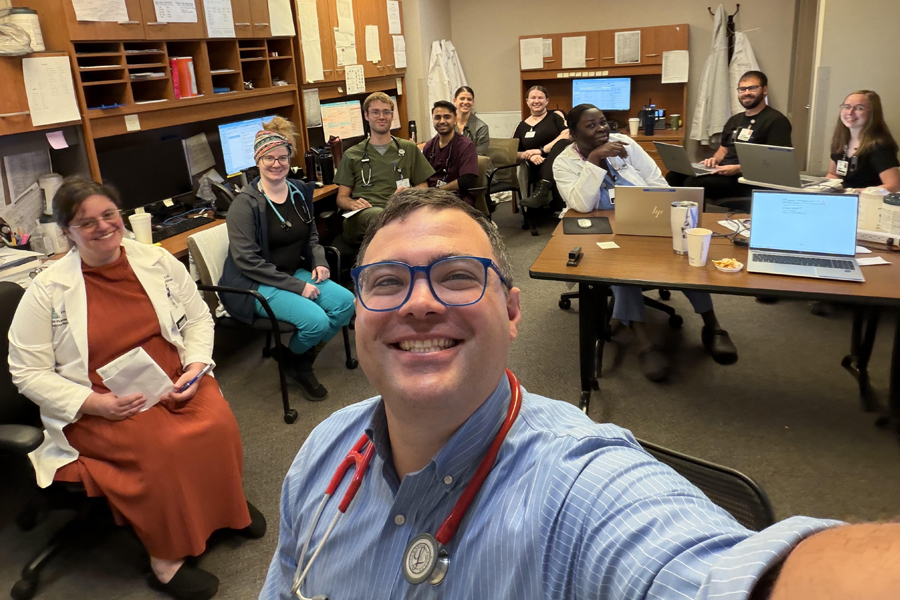
Adult and Pediatric Hospital Medicine
The Green Bay Family Medicine Residency provides a robust hospital medicine and pediatric curriculum at HSHS St. Vincent Hospital. Residents spend nine months on an unopposed academic teaching service at this regional medical center, managing a wide range of common, complex, and high-acuity adult medical conditions. Working closely with faculty, specialists, pharmacists, nursing staff, and other healthcare professionals, residents strengthen their clinical judgment, procedural skills, and leadership abilities within a collaborative multidisciplinary environment.
Residents with a particular interest in hospital medicine can pursue additional inpatient experiences with graduated autonomy, including opportunities to function in an independent hospitalist role. They may also complete additional rotations in the intensive care unit, gaining valuable experience in the management of critically ill patients, and spend more time working as nocturnists while covering the hospital overnight. St. Vincent Hospital offers excellent training in hospital-based procedures, including endotracheal intubation, arterial line placement, thoracentesis, and paracentesis. As their skills and confidence develop, residents also have opportunities to lead Code Blue resuscitations and rapid response events throughout the hospital.
Residents additionally gain hands-on pediatric experience at HSHS St. Vincent Children’s Hospital, caring for children with acute and chronic illnesses under the guidance of experienced pediatric and pediatric intensive care physicians. They learn to recognize and manage critically ill pediatric patients while developing the communication skills needed to navigate the complex relationships among children, families, and healthcare professionals.

Medical Student Education Curriculum
The MCW-Prevea Green Bay Family Medicine Residency has a strong academic partnership with the Medical College of Wisconsin-Green Bay regional campus. All residents regularly work with medical students in clinical settings, providing bedside teaching, supervision, mentorship, and feedback throughout the students’ training. Residents also receive formal instruction in medical education techniques, helping them become more effective teachers and preparing them to support future learners in both academic and community practice.
Residents with a particular interest in academic medicine may pursue an enhanced academic track with expanded opportunities to teach across the medical school curriculum. These residents can facilitate interactive, patient-based discussions during MCW-Green Bay’s preclinical years, teach students during the Family Medicine Clerkship, and help senior medical students prepare for residency during their final phase of training. This focused experience allows residents to develop advanced skills in teaching, curriculum delivery, learner assessment, and educational leadership.
Orthopedics/Sports Medicine
MCW-Prevea Family Medicine residents receive comprehensive sports medicine training under the supervision of physicians who are dually certified in Family Medicine and Sports Medicine. In a community known for its passion for athletics, residents gain hands-on experience providing sideline coverage and training room care for collegiate and high school teams. Residents with a focused interest in sports medicine can pursue extensive event coverage, build meaningful relationships with collegiate athletes, and help guide them through injury prevention, recovery, rehabilitation, and return-to-play decisions over the course of their athletic seasons. With five sports medicine physicians across Prevea Health covering a wide variety of teams and athletic events, residents have access to a broad range of mentorship, clinical experiences, and professional connections.
All residents develop competence in pre-participation evaluations, injury prevention, musculoskeletal assessment, acute injury management, rehabilitation, and return-to-sport planning. Residents may also spend dedicated clinical time with orthopedic surgeons caring for patients with advanced musculoskeletal conditions. Under the guidance of sports medicine and orthopedic faculty, residents refine their musculoskeletal examination skills, gain confidence with casting and splinting, and routinely perform office-based procedures such as arthrocentesis and joint injections. For residents seeking a career in sports medicine, the program offers the clinical volume, mentorship, sideline experience, and longitudinal athlete care needed to become competitive fellowship applicants. The program has an established record of success, with multiple graduates matching into Sports Medicine fellowships.

Geriatric and Nursing Home Care
The MCW-Prevea Green Bay Family Medicine Residency Program provides residents with meaningful, longitudinal experience caring for older adults in both clinic and nursing home settings. During the PGY-2 and PGY-3 years, residents spend a half day every other month working alongside experienced faculty while managing their own panel of nursing home patients. A dedicated geriatrics rotation offers additional immersion, including comprehensive patient intakes and the evaluation and management of acute, chronic, functional, and cognitive concerns across a larger patient panel. Because our residency clinic serves a population that tends to skew older, residents have ample opportunity to build continuity panels that include medically complex geriatric patients and develop long-term relationships with them and their families. Residents who choose to focus their training on care of older adults can pursue expanded nursing home experiences and work closely with board-certified geriatricians, allowing them to develop greater expertise in multimorbidity, polypharmacy, dementia care, goals-of-care conversations, and transitions between care settings. This comprehensive experience prepares graduates to provide thoughtful, compassionate, and highly skilled care to an aging population.
Rural and Family Medicine Obstetrics Track
All residents in the MCW-Prevea Green Bay Family Medicine Residency complete two consecutive months of high-volume obstetrics training at HSHS St. Vincent Hospital, typically participating in 20 to 30 deliveries while developing expertise in labor management, postpartum care, outpatient prenatal care, and common gynecologic conditions. Residents also provide longitudinal prenatal care in the family medicine residency clinic, following patients throughout pregnancy and participating in continuity deliveries for patients with whom they have established meaningful therapeutic relationships.
Residents seeking advanced training in family medicine obstetrics can pursue additional rural and high-volume experiences throughout Wisconsin. Opportunities include rural obstetrics rotations with Tamarack Health in Ashland, the Menominee Tribal Clinic with deliveries at ThedaCare Medical Center-Shawano, and longitudinal prenatal care at the Oneida Community Health Center. Residents may also rotate with other family medicine residency programs across the state to further expand their delivery volume and prepare for independent rural obstetric practice. Our program has successfully matched graduates into Family Medicine Obstetrics fellowships and can provide the clinical volume, mentorship, and individualized training needed to become a confident FM-OB physician. At the same time, residents who do not plan to include obstetrics in their future practice can meet their ACGME delivery requirements and then devote additional elective time to other areas of professional interest.
